
Select Flags of the American Revolution
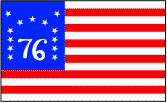
Bennington - On August 16, 1777, at Bennington, Vermont, General John Stark defeated a large raiding force sent by Burgoyne to capture American supplies stored there. This presaged the great British defeat at Saratoga. Note that this is the only American flag to begin with a white stripe.
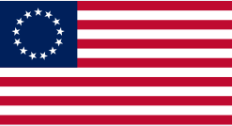
Betsy Ross - The Betsy Ross flag is an early design for the flag of the United States that first appeared in a painting of George Washington at Trenton by John Trumbull.[1] This flag had red stripes outermost and stars arranged in a circle. The name, first used more than 100 years after the flag appeared in a painting, stems from the legend that a Philadelphia upholsterer, Elizabeth "Betsy" Ross, designed and produced this flag.
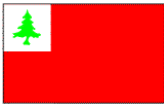
Continental - The Continental Flag, also known as the Trumbull Flag, is said to have been flown by American forces at the Battle of Bunker Hill on June 17, 1775. It originates from New England, featuring an iconic green pine tree, which was a symbol of the colony at the time.
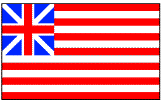
Grand Union - Combining the Meteor flag with the Sons of Liberty flag, this was first raised at sea on December 3, 1775 by John Paul Jones; and on land on January 1, 1776, on Prospect Hill (then called Mount Pisgah) in Somerville, Massachusetts, when the Continental Army was mustered into formal existence. It received its’ name from a reference as the “Grand Union Flag” in one of George Washington’s letters. Curiously, this flag was never officially sanctioned by the Continental Congress. Flying aboard a patriot ship, it received the first foreign salute to an American flag from Governor De Graaff of St. Eustatius Island on November 16, 1776.
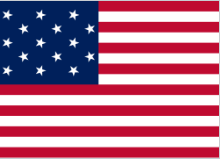
The Star-Spangled Banner, or the Great Garrison Flag, was the garrison flag that flew over Fort McHenry in Baltimore Harbor during the naval portion of the Battle of Baltimore during the War of 1812. It is on exhibit at the National Museum of American History, Smithsonian Institution. Seeing the flag flying over Fort McHenry on the morning of September 14, 1814, after the battle ended, Francis Scott Key was inspired to write the poem "Defence of Fort M'Henry". These words were written by Key and set to the tune of "To Anacreon in Heaven", a popular song at the time, by John Stafford Smith. In 1931, the song became the national anthem of the United States.
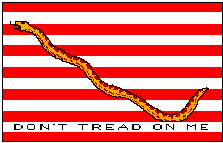
First Navy Jack - The earliest of the national “rattlesnake flags”, this one flew over the Navy’s first ship, the ALFRED, in January, 1776.